Hot Figure Toys 11" Japan Anime Sexy Doll Keumaya Final Hyper Nurse Commander Erika Naked PVC Sailo

Showing posts with label Spider monkeys. Show all posts

Just hanging around: Abandoned monkey who's the cutest baby in the zoo

By DAILY MAIL REPORTER

Hanging tough: The baby Spider Monkey which is native to Central America, is currently receiving six feeds of formula a day and is now slowly being introduced to solid foods


With her huge doe eyes and fluffy hair, it's hard to believe that this baby spider monkey was abandoned by her mother at birth.

Little Estela and her mother Sunshine failed to bond after she was born in January forcing primate keepers at Melbourne Zoo to step in and care for her around the clock to ensure her survival.

Primate supervisor Jess McKelson and her team have had to feed the tiny newborn a formula mixture by hand to build up her strength.


What a cutie! It seems hard to believe that this adorable baby spider monkey was abandoned by its mother, but at least grandmother Sonya is on hand at Melbourne Zoo to ensure little Estela is behaving herself


But the playful youngster is growing bigger by the day and is now being introduced to solid food.

Luckily, grandmother Sonya is on hand to keep a watchful eye on the mischievous toddler who thinks nothing of playfully teasing and prodding her surrogate family.


Cheeky monkey: Primate supervisor Jess McKelson and her team have been looking after Estela around the clock since she was abandoned. The playful youngster seems perfectly at home teasing her new carers with a poke in the eye though


Spider monkeys are often found in the tropical forests of Central and South America, from southern Mexico to Brazil.

They have disproportionately long limbs and a long prehensile tail makes them one of the largest New World monkeys and gives rise to their common name.


Playtime: It looks like Estela's grandmother Sonya is in for a rough ride as the tiny spider monkey playfully pulls her ear


Spider monkeys usually live in the upper layers of the rainforest and forage in the high canopy, from 25 to 30metres (82 to 98ft).

They primarily eat fruit, but will also occasionally consume leaves, flowers, and insects.

Due to their large size, spider monkeys require large tracts of moist evergreen forests and prefer undisturbed primary rainforest.

They are social animals and live in bands of up to 35, but will split up to forage during the day.


Here's looking at you, kid! Impossibly cut, little Estela is a firm favourite with primate supervisor Jess McKelson (pictured here) at Melbourne Zoo who is helping the baby spider monkey adapt after she was abandoned by her mother, Sunshine

source: dailymail

Will you be my mum? Spider monkey rejected by its mother clings to teddy

By OLIVER PICKUP

Clinging on: A cuddly toy plays surrogate mother to two-month-old Estela, who was rejected by her own mother


This baby spider monkey clings on to the back of a stuffed version of herself, looking for familiar love and warmth, having been abandoned by her real mother when she was born.

Keepers at Melbourne Zoo in south-eastern Australia are working around the clock to look after tiny Estela, who was born on January 17.

Without maternal love and guidance, she has not had the opportunity to develop normally and carers, who fear for Estela's life, are even taking turns to sleep next to the fragile two-month-old so that she can be nursed back to strength after been traumatised.

Her mother, Sunshine, rejected her baby and the pain has hard to take for Estela.

After witnessing Estela being shunned, the keepers stepped in an nursed the spider monkey's feelings.

They found that this stuffed monkey and some other cuddly toys would be able to provide some vital love and support for the two-month-old baby.

Estela even sleeps strapped to the back of a toy cat - thanks to a tightly wrapped towel - and, in the absence of his real mother, these stuffed animals give her love.


Night time: Estela takes a nap on the back of another cuddly toy


Open wide: The staff at Melbourne Zoo are working around the clock to ensure the little spider monkey gains her strength


Jess McKelson, a primate supervisor at the zoo, said that the past few weeks have been very anxious for everyone in her department.

'We're taking turns to stay overnight with Estela to monitor her condition and provide the overnight feeds,' she said.

'Keeping Estela alive has been a big challenge, and she has had ups and downs over this time, with several infections that have been a real threat to her survival.

'Our veterinary department has been right there for us, ensuring that Estela has had the best possible chance of surviving'.


Keeping watch: The keepers will observer Estela while she dozes off, until such time she is strong enough


Spider monkeys are often found in the tropical forests of Central and South America, from southern Mexico to Brazil.

They have disproportionately long limbs and a long prehensile tail makes them one of the largest New World monkeys and gives rise to their common name.

Spider monkeys usually live in the upper layers of the rainforest and forage in the high canopy, from 25 to 30 metres (82 to 98 ft).

They primarily eat fruits, but will also occasionally consume leaves, flowers, and insects.

Due to their large size, spider monkeys require large tracts of moist evergreen forests and prefer undisturbed primary rainforest.

They are social animals and live in bands of up to 35 individuals but will split up to forage during the day.


source: dailymail

Spider monkeys and their friends at London Zoo


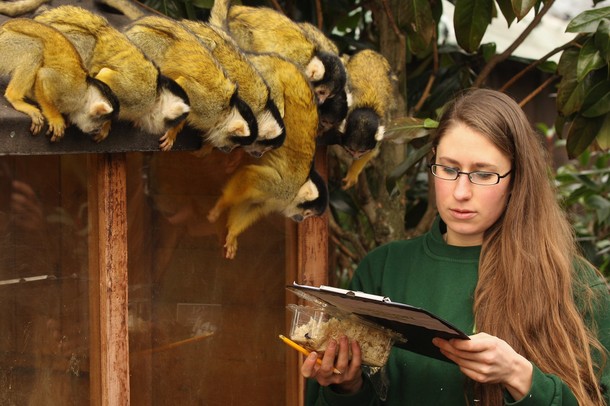
Zookeeper Kate Sanders poses for photographers with a group of spider monkeys during the annual stocktake at London Zoo, north London, on January 4, 2011. With over 16,000 creatures, the headcount will include 10,000 invertebrates, 4,700 fish and 100 reptiles.


A photographer gets close to some squirrel monkeys during a photo-call media event to mark the annual stock-take at London Zoo in London, Tuesday, Jan. 4, 2011. The zoo, which houses over 700 species of animals, is required to carry out the annual head count of all their animals as part of their zoo license


LONDON, ENGLAND - JANUARY 04: Zoo keeper Kate Sanders makes note of the Spider Monkeys as she conducts ZSL London Zoo's annual stocktake on January 1, 2011 in London, England. London Zoo is home to over 16,000 animals from over 700 different species including over 10,000 invertebrates, 4,700 fish and 100 reptiles.


Senior keeper Mark Tansley poses with a locust during the ZSL London Zoo's annual inventory count in London January 4, 2011. Zookeepers are conducting an annual headcount on over 16,000 different creatures including over 10,000 invertebrates, 4,700 fish and 100 reptiles.


Insect keeper Kate Pearce poses with a red kneed bird-eating tarantula during the ZSL London Zoo's annual inventory count in London January 4, 2011. Zookeepers are conducting an annual headcount on over 16,000 different creatures including over 10,000 invertebrates, 4,700 fish and 100 reptiles.


Mammal keeper Angela Ryan poses with Llamas during the ZSL London Zoo's annual inventory count in London January 4, 2011. Zookeepers are conducting an annual headcount on over 16,000 different creatures including over 10,000 invertebrates, 4,700 fish and 100 reptiles.


Mammal keeper Angela Ryan coaxes a meerkat for the benefit of photographers during the ZSL London Zoo's annual inventory count in London January 4, 2011. Zookeepers are conducting an annual headcount on over 16,000 different creatures including over 10,000 invertebrates, 4,700 fish and 100 reptiles


Zookeeper Evelyn Guyett poses for photographers with flamingos during the annual stocktake at London Zoo, north London on January 4, 2011. With over 16,000 creatures, the headcount will include 10,000 invertebrates, 4,700 fish and 100 reptiles.


LONDON, ENGLAND - JANUARY 04: Zoo keeper Kate Sanders makes note of the Spider Monkeys as she conducts ZSL London Zoo's annual stocktake on January 1, 2011 in London, England. London Zoo is home to over 16,000 animals from over 700 different species including over 10,000 invertebrates, 4,700 fish and 100 reptiles.


Zookeeper Kate Sanders poses for photographers with a group of spider monkeys during the annual stocktake at London Zoo, north London, on January 4, 2011. With over 16,000 creatures, the headcount will include 10,000 invertebrates, 4,700 fish and 100 reptiles.


LONDON, ENGLAND - JANUARY 04: A Bolivian squirrel monkey sits in its enclosure during the ZSL London Zoo's annual stocktake on January 4, 2011 in London, England. London Zoo is home to over 16,000 animals from over 700 different species including over 10,000 invertebrates, 4,700 fish and 100 reptiles.


source : Daylife
photo: AP photo, Gettyimages, Reuters